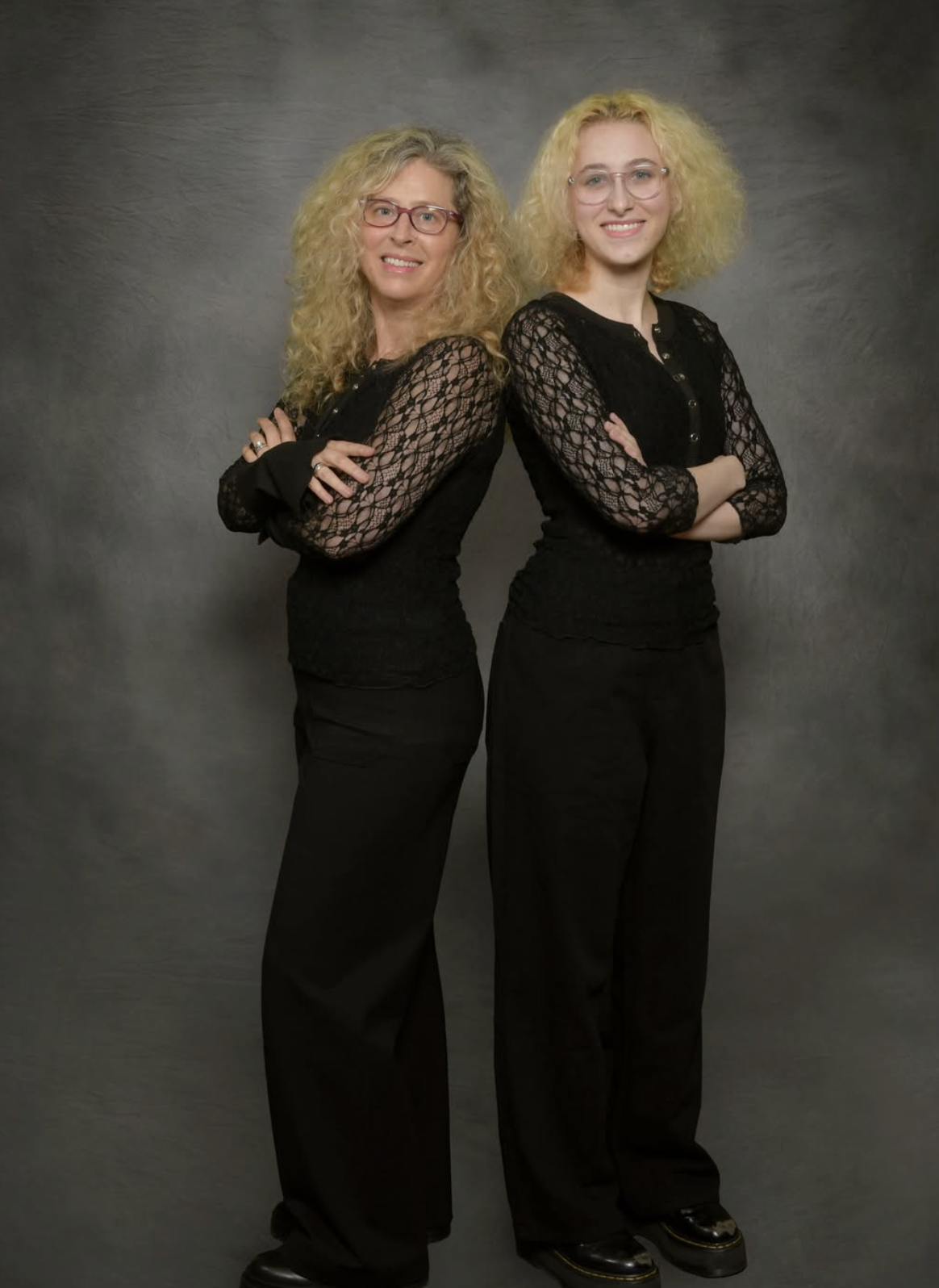
What happens when a life-changing diagnosis becomes the beginning of a greater mission? Mother-daughter duo Corrina Clover Miller and Marta Eliza Miller join Kara Duffy to share their journey from figure skating and entertainment to founding the Marta Eliza Miller Foundation, an organization dedicated to scoliosis awareness, research, and supporting young athletes.
Together they discuss turning fear into action, building a nonprofit from a difficult moment, homeschooling on the road, chasing creative dreams, and what it means to create a life outside traditional expectations. Marta and Corinna share how resilience, curiosity, and community have shaped their mission to help others stand tall, be strong, and dream big.
“You don’t see scoliosis unless you’re looking at someone’s back...that’s why awareness is extremely important, because there’s so many things a part of it that we just don’t know about.”
-
-
Episode 371: Corinna Clover Miller and Marta Eliza Miller.
===
[00:00:00]
Kara Duffy: Welcome to the Powerful Ladies Podcast. I'm Kara Duffy, and today's guests are mother-daughter power duo Corinna Miller and Marta Eliza Miller. By day, Corinna is managing world-famous musicians, and Marta is a musical theater actor. However, they've combined their power to become leading fundraisers for the Spine Center location in the Jackie and Gene Autry Orthopedic Center for Scoliosis and helped fund CHLA's launch of the New Momentum app.
In this episode, we discuss their journey to building their Marta Eliza Miller Foundation, their experience with scoliosis, raising a family while traveling the world, and why they can't help but keep adding new projects and adventures to their to-do lists.
Welcome to the Powerful Ladies podcast
Marta Eliza Miller: Good to be here. Thank you ... here. Thank you
Kara Duffy: Let's begin. Um, let's tell everyone your [00:01:00] names, where you are in the world, and what you're up to.
Marta Eliza Miller: Hi, my name is Marta Eliza Miller. I'm 19 years old. I currently live in Hot Springs, Arkansas because I'm currently in a production of Sweeney Todd where I am a choreographer and dance captain, and- I am her mother. My name is Corrina Clover Miller, and I'm here with her in Hot Springs.
I live bicoastal between Los Angeles and New York. And we're the co-founders of the Marta Eliza Miller Foundation
Kara Duffy: Perfect. Well, there's just so many things going on in all of this. Um, before we get into what you guys are, are spending your time and h- what you're doing, I wanna talk about just living bicoastal and following work. Have you, always lived bicoastal, or is that new?
Marta Eliza Miller: Well, I work in the entertainment industry, and so Marta has spent the majority of her life on the road. Yeah. And so we've traveled all over the world, in fact, twice around the world. Currently living bicoastal or, or tri-coastal almost- Yeah ... since we're near water [00:02:00] in Hot Springs, Arkansas- Yeah definitely is something that we're both used to. Yeah.
Kara Duffy: And how do you guys make that work? Is it just truly two, two houses filled with all your things and you just show up and you click back into life in New York or life in LA? Or, um, are you bringing more things on your back like a turtle?
Marta Eliza Miller: I mean, right now we're m- moving into our apartment in New York because I plan on, you know, start auditioning for, like, Broadway shows and all of that. So I have, like, a little bit of clothes in LA, a little bit of clothes here in Hot Springs, Arkansas, and a little bit of clothes eventually in New York. Yeah. And, and living on the road- Yeah ... when you're, when you travel on the road, I mean, yeah, you do carry a lot with you. You've got your laptop. Uh, at least for me, my work can be remote. Cell phones have done a wonders- Yeah, yeah ... like, over the last 25, 30 years, things have changed, which has made l- you know, working from almost anywhere at any time absolutely possible.
Kara Duffy: You guys have come together to do a pretty powerful thing. [00:03:00] Um, so let's talk about the foundation. How did it start? You guys are making some crazy metrics that's getting you a lot of attention. So let's just go to the origin story of the foundation.
Marta Eliza Miller: Okay, so I, um, I started, uh, figure skating when I was seven years old. And from like when I was around like 10 years old, my mom started noticing because, um, I looked down a lot when I skated. Um, and we started using posture braces because, like, that's what my coach at the time, like, suggested. And so we did that, and, like, it kept shifting to one side and you can s- yeah I was literally sitting there one day watching her and, you know, we, we'd gone through a couple different Amazon posture braces and I was, all of a sudden I just thought, "I wonder if she has scoliosis."
And so initially it was a self-diagnosis and we went to a doctor that I found, uh, in Orange County and, uh, we determined that she did have mild scoliosis at the time. Had a [00:04:00] 19-degree curve. And we put her in a flexible brace because, I was on the road so much, uh, in the music business and I homeschooled Marta, I used figure skating as her physical activity. So she was skating initially not to be competitive, but because it was a way that every single day she could have a physical activity no matter where we were. And so she would wear the flexible brace and it worked really well. And then, uh, at a certain point she injured herself while she was skating.
Yeah, so I was doing a double Lutz on the ice and I fell really hard and so I injured my hip flexor. And so my mom decided to take me to Children's Hospital Los Angeles, and that's the first ever time I went there. And, um, we did X-rays, we did all of that. And then, um, the doctor at the time, uh, was a sports doctor because it was a sports-related injury, and she noticed that I had scoliosis and also a shorter left leg, which we did not know at the time.
And so she asked if we would [00:05:00] like her to monitor my scoliosis, and that's when our first, like, interaction with, uh, Children's Hospital happened. And honestly, when I, like, stepped in there, it, it became like a second home immediately. It's one of the best places ever and Everyone's just so nice there, and it literally becomes your second home.
And, she specifically suggested to do the motion lab and motion study, and, uh, we did a bunch of different stuff, and that's what led me to become a, uh, junior ambassador for Children's Hospital Los Angeles. And all of this leads to why we started the foundation. Yeah. It is kind of a long story. Yeah.
But so Marta became really involved with Children's Hospital and started raising money for Children's Hospital, and because she loved the hospital so much, she was doing speaking events for them. She en- ended up actually getting, uh, invited to speak f- in front of the board of trustees at the California Club, which was very prestigious.
It was. Um- It was really huge. And but also, she was still skating, and her curve was progressively [00:06:00] getting larger and larger. And at a certain point, the sports doctor, uh, felt that Marta needed to see the head of orthopedic at Children's Hospital because the curve had reached 48 degrees. So it had changed drastically from, uh, 19 all the way to 48.
The sports doctor had said, you know, "I think you might need surgery." Yeah. "I'm really concerned- It was kind of scary ... about the curve." And so I think it was right then in that moment that- I, I noticed fear in, in, in Marta because, uh, to that point she had just seen the hospital as her friend.
You know, it was like she went there, she learned about her body, she learned how to do exercises, how to work with her curve, what the difference of having the short leg did, how it affected her skating. But it was all a learning, educational process, and she was enjoying it. And all of a sudden there was this cloud of fear of, "Okay, you may need to have surgery."
And so we saw the doctor and he said, "I really wanna do three different MRIs. It's gonna be a long session, [00:07:00] you know, three hours. Uh, you're gonna need to be in a tube, you know, the MRI, and, but we've got special ones here at Children's Hospital." But then compounding with that, it was the week before COVID shut down.
Yeah, so it, it was, like, really, like, scary. And when we went to go do the MRI, it was really late at night, and also very ominous, for me, like, talking about it sometimes brings up, feelings that stress me out and all of that because it's not traumatic, but it was just during, like, a time where, like, things were kind of becoming scary, and also not knowing if I had to have surgery or what was going on.
And also, like, figure skating too, like, not knowing if I could continue that was just, like, a whole process that was, like, really hard for me, and I was, like, only 13 at the time, so yeah. And so it was that weekend while we were waiting for the results, I was just trying to figure out a way to help Marta kind of cope with what she was going through.
And I work in the music business, [00:08:00] and the artists that, we represent have done a lot of benefit concerts, so Marta grew up watching us produce benefits and doing things for other people. So we were at dinner and I said, "You know, what if we made a foundation?" 'Cause I was thinking, "Okay, if she can't skate," and this has been something that has been such a large part of her life, like five days a week.
Yeah. You know, at that point she was skating four hours a day because she loved it. I was skating 20 hours a week. I was skating a lot every single day. And, and competing. Yeah. And it, it had reached a completely different level than it had initially started with. And so- I just said, "You know, what if we started a foundation because we could give back to other young athletes who might be in a similar situation."
And sometimes things happen for a reason. So if for some reason you can't continue skating, like, we can turn that into a positive. And a way that we could turn that into a positive, we could create a foundation, and the whole purpose of it could be to, to educate and, y- you know, if we're lucky, provide money [00:09:00] to help do research.
Uh, but mainly empower young athletes to know that having scoliosis isn't an end-all. Yeah. And you, you- Yeah. I love the idea. We started coming up with, like, a, like, little saying for it, which was, like, really fun. We even came up with merch, and it really made me feel, like, a lot better about the situation during a very stressful time.
But also, when we got the results from, uh, the MRI, the doctor told me that, like, if I wasn't feeling any pain or, like, anything, I didn't need surgery. So, like, that was also a huge relief, but then COVID happened. So, like, like, the pandemic happened. We, I wasn't skating. Um, we actually started renting out the ice rink at my home rink because, um, uh, me and my mom didn't know what to do, so I was just skating there.
We were think- coming up with ideas for the foundation, and my curve jumping, um, the pandemic, the MRI, and, like, [00:10:00] skating and just coming up with these ideas just really, like, made the foundation what it is. Like, it came out of something, like, during a really dark time to be, like, a really beautiful thing
Kara Duffy: Well, you guys are pretty busy, and then you decide to add a foundation on top.
Marta Eliza Miller: Yes
Kara Duffy: you know, were there ever moments where you're like, "Oh," like, "This all comes from a really great place, but can we do this?"
Marta Eliza Miller: Oh gosh. Yeah. Absolutely. I mean, we, we, we were doing a fundraiser in 2023- Oh my gosh ... which was actually, um, yeah, really great. It was at E- Yes, it was really great ... it was at East West, uh, which is the home of Michelle Kwan, uh, which Marta was skating at in Artesia, and we had members of the, uh, US, um, figure skating team.
Uh, we had Olympians. Uh, but I was in Japan on tour the month before, so I remember being in Japan. Marta was at home. And I was in, I was in a musical at the time, and so I also had that on top of everything, and it was crazy. But we put the show together, but [00:11:00] literally three days, three days before the show, my ice dance partner threw out his back.
And so, yeah. So I had to work with my previous ice dance partner, and he learned the whole entire routine for the show. So, so that they could skate. So we could skate, and it was the craziest thing that has ever happened to me on the ice. It was- It was so surreal ... but it was fantastic. Yeah, it was awesome.
And it, it turned out really good. I think just because again- Yeah ... sometimes in those mo- in those moments when you have so much, not necessarily anxiety, but just- Yeah ... extra energy, it's like everything kinda moves at, more quickly. And I think we've always lived busy lives. I've always- Mm-hmm
Marta's always been on the, on the road, and she's always known what it means when, you know, Mom and Dad are at work, and she's there do- too. Yeah. She's learned how to produce shows. She's learned how to be stage manager. Yeah. She's learned how to be in shows. Yeah. And it's all been really great tools, which is why I think Marta's doing what she's doing- Yeah at, at the young age that she is. Yeah.
Kara Duffy: Well, let's get [00:12:00] into a little bit more of what you are doing because you're in this musical now. But you didn't just jump from, you know, homeschooling, figure skating to a musical in Arkansas.
Marta Eliza Miller: So, okay, um, I, um, graduated high school at age 16 with majority of my college credits already completed because I was homeschooled, and I kind of just went through school at a very accelerated pace. And I wanted to do musical theater, and so I majored with a BFA in musical theater at the American Musical Dramatic Academy Performing Arts College, which I graduated from in February,
Kara Duffy: Congratulations
Marta Eliza Miller: Yeah. As the youngest graduate- Yes ... in the history of the college. And I also graduated early too, so I graduated two semesters early. So
Kara Duffy: So right now people's minds are already blown of like, how did you do all of this academic work in this amount of time? Like, were you taking classes online? Were you doing some things in person to mix it? Like, are you working on school 100 hours a [00:13:00] week? Like, how are you making this happen logistically?
Marta Eliza Miller: So how, how I did it is, um, my mom was my teacher for homeschool, and, um- Through, through high school ... yes, yeah, through high- And yeah, our motto was, "Every day is a learning day- Learning day ... at Cree Boomer Academy," because we, rather than taking summer off- Yeah ... Marta would continue through the summer because we were working.
I was working full-time, and so it just made the most sense. And so when you went to college, uh, the college that she chose actually- Um ... had a tri-semester system. Yeah, they had a, they had a tri-semester system, so I just went all the way through. And, um, because I had no general ed starting at the school, I could just focus on my major, which was, like, really exciting, and I could also take some acting major classes.
I made a short film while I was at AMDA. I got to work on a play as a director for a class. Um, I got a lot of stuff out of the school, and it was really cool.
Kara Duffy: When did you first start, um, wanting to perform?
Marta Eliza Miller: [00:14:00] Oh, I mean, I think it's, I think it started at, like, age seven when I, like, started doing figure skating, and a lot of figure skaters are theater kids, so I kind of just got introduced into all of that at a very young age. And so that's just my performing. I think you actually started performing even before that because, um, I remember being at a, a tour, end of tour dinner with Marta when she was five and, uh, you know?
Yeah, I know what you're talking about. And, uh, you know, my husband and I were up there. We were talking and, uh, thanking the band. Um, we had just done 56 dates around the world. It was Crosby, Stills & Nash, who we managed at the time, and, uh, Marta was five. Mm-hmm. And, uh, we, it was just, it was a really beautiful moment because the guys hadn't toured that many dates in, in quite some time and had been really successful.
And after we spoke to the band and crew, Marta, who was five, said, "I wanna say something." And, uh, she grabbed the mic. [00:15:00] So- Do you remember? Yes, I do remember. So I grabbed the mic, and I started singing Tomorrow from Annie. The Sun- The Sun'll Come Out Tomorrow. Yeah, Tomorrow. Yeah. That was really, I think, your first- Yeah
shining, shining performance moment.
Kara Duffy: Um, so Corinna, for you, I wanna just give people a little sneak peek more into your life as well. So you're touring the world, putting on these productions, working in the music space. How did you end up doing this, and did you imagine that your life would be taking your family on the road,
Marta Eliza Miller: Yes and no. Um, I too graduated from high school early and started in the workforce early. I graduated, uh, when I was 15 from high school, but I didn't graduate from college, uh, as early as Marta. Um, I worked in news, news radio, and, uh, then I went to music radio and, um, I was actually writing for... I, I was music editor of a newspaper in Flagstaff, Arizona, and, um, I ended up going to a festival that, uh, Jackson Browne put on each year for Native [00:16:00] American scholarships.
And I interviewed him, and that's where I met, uh, my husband, Marta's father, who was Jackson's manager. And we hit it off, and I started working, uh, for him. The next year I got hired to do press for them, uh, because they were impressed with the interview, and we, we got along well. And, you know, then about two and a half years later I moved back to Los Angeles, ended up working in their office.
Um, so, you know, my husband's w- has been with Jackson Browne for, uh, almost 60 years, and I'm going on 30 years. So it, it just happened. And then the same thing, at a certain point, um, Crosby, Stills & Nash's, uh, former manager had a tragic car accident in, uh, the early 2000s, and we ended up managing Crosby, Stills & Nash, and I managed David and Graham personally, uh, through the tenure of the band.
The band broke up around 2015, and that was, um... At that point we were not on the road as [00:17:00] much. And, um, yes, I, I knew at a certain point that we were always gonna be on the road, and we chose to have one child who we could take on the road, and we always travel together as a family. And, um, you know, most of our travels have not been vacations.
They've been working, you know? But we've alway- we always managed to do things, you know, while we were on the road, and I always tried to make them educational. Mm-hmm. And I loved, I loved education. I loved learning, and it was really a pleasure to be able to teach Marta. I f- I formed a private school, which you need to do in the state of California, uh, when Marta was two, and that's really when we started homeschooling, and Marta took to it really well.
Kara Duffy: I think there's a lot of people who have these big dreams in life and see all these possibilities, but they never, um, they get stuck in the way everyone else is doing things. What's given you the either gumption or bravery [00:18:00] or determination to build a life, and this is a question for both of you, that maybe isn't traditional but you know is the right path for you?
Marta Eliza Miller: I mean, for me personally I can understand getting stuck from other people around you. I felt very much that way, um, in college, also in figure skating too, because, uh, th- there were, there was a lot of judgment, from a lot of the girls at, the rink that I skated at. Also, the same thing with coaches.
I had quite a few bad coaches. I didn't let it get me just stuck in one place. I just I persevered, I continued, I moved forward, and that's what helped me a lot in figure skating. And it also helped me a lot in college too, because I was the youngest person there at the school, and so many people did not like that, and so many people would say so many bad things about me and I was just minding my own business doing my thing, working on my major.
[00:19:00] So, you know, that kind of- broke me down a lot, but for me, I just pushed forward and knew that I'm graduating three to four semesters before any of these other people. I'm going to be in the industry before they are. Like, I just need to keep going, push forward, and I will get to where I need to be.
And now that I'm not at the school anymore, so many more opportunities have happened for me. I'm being appreciated in sp- in spaces I never thought I would be appreciated in. I mean, this is my first time ever being a choreographer and a dance captain for a show, for a show. I've choreographed three pieces for the show.
I've never done that in my life, and this is just such a major opportunity for me because I'm realizing so much more about myself that I didn't know about myself in college. And, um, I really love choreographing, and I now have another job opportunity for because I want to pursue a career in theater.
I want to be on Broadway. I want to do all of that, and I realize, oh, I can do [00:20:00] choreography if I really wanted to. I, I now have this major opportunity. It's just you have to always push forward to get to where you want to be. And I also believe in manifestation a lot because I've manifested a lot of things in my life, and they've come true, so I just, I, I really believe in that.
I, I think being an individual and owning your own power is really important. Growing up, I competed in the Optimist Speech Contest, and I think that gave me a positive outlook on life, and I'm- Mm-hmm ... not sure if it was me trying to sugarcoat the surroundings I was in, but there was something that always, I always tried to look at the positive, and I think that I try, I tried to teach that to Marta.
And, you can't shield people from negativity in the world, and as Marta indicated, she's had some incredible coaches- Yeah ... but there, there are also, in any environment, there, there is the the rotten [00:21:00] apple or the experience that you have to go through. And those experiences, as devastating as they can be or traumatic, which in in Marta's case- Yeah
there was a very traumatic situation- where we had to go through a SafeSport case and, it took a, a couple years to the point that now we can talk about it- Yeah ... and be positive about it and see the good of it, right? It, uh, because there is always something good that can come from something bad.
But also learning how to be an individual and owning your power. It's been a lesson that- Yeah ... actually Marta has continued to teach me as I go through things, 'cause we all have ups and downs. Mm-hmm. So it's, we've had a good kind of, uh, osmosis- Yeah ... type relationship- Yeah ... back and forth on, on things like that.
Kara Duffy: you have some big fundraising coming up for the foundation. Um, let's talk about that
Marta Eliza Miller: So this year we decided to go national. The foundation, we've been really fortunate. We've raised over a million dollars for scoliosis research and awareness. We decided we really wanted to go national, and so in June, which is [00:22:00] National, uh, Scoliosis Month, we will be donating to scoliosis and spine centers in each of the 50 of the United States, plus Puerto Rico.
And, um, we'll continue. Uh, we have a pledge that we are with the Children's Hospital of Los Angeles. We've, uh, donated over $475,000 to CHLA. We're also partnering now with Children's Hospital Boston. Mm-hmm. And we'll be making partnerships with, uh- Everyone. Yeah ... uh, uh, s- a spine center in each state, which will then kind of take us to the next level.
We're excited about that. But we have done something exciting too with- Yes ... research with CHLA. So from the fundraising and all of that, my current scoliosis doctor, Lindsey Andress, they created this app called Momentum with the fundraising that we did. And basically it's a way for children who have scoliosis to not go through radiation every four to six months for scoliosis, and it's this app on your phone that is a 3D scan that will scan your spine [00:23:00] and will give you an estimated curvature of your spine, and you do it every single month.
And it's super cool, and it's super exciting, and I can't wait to see how it moves forward because it just, it's so innovative, and it's just great. Marta gets to be one of the- Yes ... prototypes because even though she's no longer considered a patient of- Yeah ... Children's Hospital because she's technically graduated now- Yeah
she's an- It is ... adult w- we know what her spine has been for the last three years, which is, it ranges between, uh- 30 to 32 degrees, depending on if I wear a lift in my shoe on my, uh, left leg. Yeah. And so we can monitor it with Momentum, and each month the curve has been around 28, so it's not exactly, but that's the whole point, is to be able to take someone like Marta, who we have a pretty good idea of what her curve is, and monitor it.
And they're, they're using it with, I think, 50 patients, uh- Yeah ... right now, so, uh, or thereabout, and it's just a really great thing that's happening. Yeah.
Kara Duffy: Well, I have so many more questions now [00:24:00] about scoliosis because it's not something that most people know. We know of it, but we don't really know, okay, you, you have it, then what? How much can your spine move once you're diagnosed, and are, is the goal to keep it in a range or move it? Like, what is kind of the strategy once you're diagnosed?
Marta Eliza Miller: Well, the thing is there are no two cases alike Yeah ... and that is the challenge with scoliosis. And so if you think about your spine, you can have there, there's S curves. You can have an S curve to the right. You can have an S curve to the left. It can move 360 degrees. So there's several different curves.
No curve is the same. Um, scoliosis i- in terms of how it's diagnosed, um is a challenge because typically they do it around puberty, right? With girls, uh, and boys, but typically th- they find it in girls more often. Um, you know, in PE class, they bend you over, they measure your back. Uh, you don't always find it that way.
Some people with scoliosis never have pain. [00:25:00] Marta hasn't had pain per se, although there have been some movements- Yeah ... that she hasn't been able to do or that have been more challenging or just not good for her curve. Yeah. Um, there are a lot of things that we're finding out about scoliosis such as it's not just about the physical, uh, movement of your spine, but there are neurological aspects of it.
There are there are mental aspects of it. There are emotional aspects of it because it's, it's your spine. It's your spinal cord and so that affects- Yeah ... you know, quite a bit. And we've kind of- It affects your brain. Yeah. It, it affects literally everything, and not every case is like the same. So it's just like really hard to-- It's not hard to treat, but there's so many options for treatment, it can be like, it, it can be crazy.
Some people really need surgery. I mean, some people's curves are are m- very substantial and, and affect, um, their ability to, to walk or to sit. So sometimes surgery is necessary, and there are [00:26:00] several surgeries. In fact, there's a fusion surgery. There's a new surgery that uses tethers that, um- Lengthen your spine as you grow.
Right. Yeah. And, um, there's just, there's a lot of research that's being done. And that's the, that's the thing about our foundation. We, we don't ever want to impart that one way is better than the other because it really can't be. And the other thing is there's two types of scoliosis. There's congenital, which means you're born with it.
There's idiopathic it means it, it appears at a certain point in your life. That alone is hard to, uh, actually diagnose because unless you catch it when a child is a baby because you're doing other procedures, you don't necessarily know whether it's congenital or idiopathic. I don't know if Marta was born with it.
We actually found out I have scoliosis, which I didn't find out until a year and a half ago. Her father has a shorter leg, so we always joked, "Oh, she got it from you." Well, his spine's straight. It just, um... But yeah, the goal is to [00:27:00] make sure that you don't have pain. Mm-hmm. Uh, that as it grows, if there is that you keep the curve from getting greater.
Um, we noticed an interesting correlation as Marta's teeth, when we straightened her teeth That's when her curve changed the most drastic. Now, whether or not there it's debatable whether or not teeth has something to do with scoliosis, though there have been some studies that have said the development of teeth and bone do have a correlation.
Uh, Marta's metabolism is incredibly crazy. She metaboli- me- metabolizes, incredibly fast, which created, uh, a huge situation while she was ice skating, because she would get on the ice, and within five minutes of being on the ice, she would be worn out, whereas some coaches would think, "Oh, she just doesn't wanna skate."
Now, she actually had no physical ability, so we had to go through this process of learning about electrolytes- Mm-hmm ... and how to keep her physically functioning. So it's just a lot, and there are a few [00:28:00] foundations that have been doing this for 30 years or longer, working with doctors all over the world, trying to figure out ways to decipher more about scoliosis and and figure out ways to help others.
But really, awareness is a big part of it, because we don't talk about it. Yeah. And I, I think awareness is, like, extremely important because, as I mentioned, I have had bad coaches in the past, and I did get a lot of backlash with my diagnosis and I became an ice dancer, and we do a lot of d- different dances on the ice.
We do tangos, we do cha - chas, we do waltzes. We do everything, pretty much. And there was this one dance that I could not physically do, and that was the foxtrot, because of one move where it actually would start making my left side, which is the side that, of my back that we do not want cramping up or engaged, started engaging and it started actually making me have physical pain.
And the coach I had th- at the time did [00:29:00] not believe me. Like, when I first said I had a foundation, she was like, "Why do you have a foundation? What's the point of scoliosis awareness? Why do you have it?" And that was, like, a really hard thing to go through, because it's like- I was like, I think 13 or 14 at the time, and like I, I didn't know how to explain to a lady who was like in her 50s about why I have this foundation.
That's just like such a weird dynamic to have on the ice. And a lot of people don't talk about a lot of stuff with like coaches and them like not being nice to you in figure skating. It's just not talked about. It's just normal. It- they normalize it, which is not good.
Kara Duffy: Hmm.
Marta Eliza Miller: And it, it, that's like with anything. Yeah. But talking about scoliosis - Yeah ... that's the thing. It's, it's silent. Yeah. You don't see it unless- Yeah ... you're looking at someone's back, and usually we have clothes on. Yeah. And again, some cases are more drastic, but , for mild scoliosis, which can affect people tremendously even with a mild curve, you could be in more pain or not be able to do things. It's, it's something that needs to be talked about. Yeah.
Kara Duffy: Do [00:30:00] you have stats on like what percentage of the, of the population is diagnosed with scoliosis or they think might have it?
Marta Eliza Miller: 2% is diagnosed with scoliosis. But probably more like 7% have it. How you get scoliosis, I mean, that was one thing, was we, we weren't sure. Was Marta's, uh, curve changing because she was doing jumps on the ice? That's actually debatable. Some doctors would say, "Oh, it could have a huge impact."
Other doctors would say, "Well, it's her spine. No, her spine's not gonna move that much unless she's like, you know, injuring herself when she's jumping," which if there's no pain, she's not, and like the spacing of her spine seems like it's not compressing. It's just, it's... There, there's a lot of unanswered questions, and I don't know how they'll all be answered over time other than talking about it.
And that's the one thing that we've found. We've created this community which has been really, uh, exciting because we meet people who say, "Oh my goodness, I have scoliosis," and, "This happened to me," and "I've never felt like I could talk to anybody about it because they didn't [00:31:00] understand," or, or, "I got bad feedback here because I couldn't do certain things, and now that I know you felt that way too, like it makes me feel like it's okay." And that was really the whole purpose of the foundation.
Kara Duffy: And I imagine that like anyone who gets diagnosed with something, you start to really appreciate when they have, um, the American with Disabilities Act and what this is doing, and I don't think people realize how many things are covered under that. And whether you either from age or an injury or a diagnosis, sh- uh, permanent or temporary, everyone falls under it.
I mean, if you're pregnant, you're technically disabled in the US. So I think that there's room for so much compassion in, uh, the US today and giving space for everyone to be able to excel in the ways that they can. And it's super impressive how much you guys have been able to accomplish with the [00:32:00] foundation so far. Um, what are your goals with where you want to take it?
Marta Eliza Miller: Um, I mean, honestly, kind of just making people more aware about it. I think people just learning about it is really important. Research, learning more about what's going on, what to do, more innovative ways to protect your spine more treatments, all of that. The goal is to learn more about it because most people don't wanna learn about it.
They just wanna push it to the side because it's not that important. I believe it's important and it's important to talk about because there's so many things a part of it that we just don't know about. When connecting with children's hospitals nationwide has been really exciting because there's a network of mothers typically, fathers also, but typically parents, I'll just say, and their children who experience it.
In February, right around the time of Marta graduating, there was a young figure skater on the East Coast who was getting [00:33:00] fitted for a brace, and the hospital where she was getting fitted, the children's hospital, reached out to us because the mother had heard about our foundation, and, w- the f- the hospital wanted to know if Marta could connect with the young skater because it, it was just a way to make the skater feel like it was gonna be okay.
And that's what our motto's always been. It's stand tall, be strong, dream big. Stand tall, be strong, dream big. And the purpose of that is, yeah, stand tall 'cause of scoliosis, you always... and with anything, you always wanna stand, and be your most proud.
Um, but also be strong. I mean, be strong physically, mentally, emotionally. And to dream big, knowing that whatever you set your mind to, you can make happen. And, and okay, take that with a grain of salt in the extent that, okay, if you're wheelchair-bound, maybe you'll, you won't be able to get out of the wheelchair, but that doesn't mean that you're not able to do incredible things that you [00:34:00] put your mind to.
And, that for us, reaching to community and having people reach out to us and just feel, say that they feel like they've been validated or they've been heard, it feels really good, and it makes us feel validated. Yeah. And again, every day we find out somebody else who has scoliosis or whose grandmother had scoliosis, and she had surgery, or she never had surgery and it for her whole life she wasn't able to stand up, and they always wondered, why she was in so much pain.
And it's just the stories that we hear. I think the more we have that in our world, maybe the less divisive- Yeah ... our society will be.
Kara Duffy: Yeah. You know, I read that when you got diagnosed, because you were already fit from being an athlete, that you had an advantage, and you still had to do a lot of work in the self-care space. How much do you prioritize taking care of yourself today since the diagnosis? And the second part of that question [00:35:00] is, with all the traveling that you guys do, how do you make sure you're fitting in the care that you need to do to keep yourself at your best?
Marta Eliza Miller: for me, like over time, it's mostly been like core exercises that like really help me. That is just something really easy that I can do pretty much anywhere. And the thing is, already from figure skating, like I had a pretty strong core from because I was doing jumps every day, I was doing squats every day, I was doing pretty much everything that I could to be strong when landing an axle or like any figure skating jump or like doing pretty much anything on the ice.
And also stretching and yoga has like also helped me a lot. I mean I, I haven't had a problem being, like, on the road and not doing exercises because, I can do stretching, I can do core workouts, I can do workouts pretty much anywhere as long as I have a rug or a nice solid surface that isn't too hard.
I can just prop up my phone, put on a YouTube video of a core workout and [00:36:00] just do it. And that's, I think, what's been neat to watch with Marta is when we started out when she was 10, there were, like, really specific exercises that I would make sure she did every day.
And it was ... And they were interesting. They weren't always normal exercises. It'd be like, "Lean to the this side, and flex this back muscle 10 times." And so we really did that quite a bit for when she was 10, 11, 12. She had a great figure skating coach at the time who was really positive and would take any input that I provided from her doctors in terms of what she needed to do.
Like, if she was doing a, a spin or a jump on one side, even if she didn't jump the other way, you would still practice that just to get your body and your spine moving the opposite direction. And sometimes you'd do one thing twice to the left and once on the right. So, but going through all of that where it was actually way more structured, because I was, I had, I was involved with [00:37:00] it. In college at AMDA, I was dancing every single day I was doing physical activity, um, all the time. And the way AMDA's program is structured, it's very much like how to sustain eight days a week on Broadway, and majority of the shows currently on Broadway have people, have alumni from AMDA.
The school pretty much just trains you in a conservatory style to get you where you need to be for e- eight shows a week.
Kara Duffy: Mm-hmm.
Marta Eliza Miller: And, and- You know, doing a three-hour marathon. And it's fulfilling to me- Yeah ... to see Marta find other things. Like, while she's been here in Hot Springs, she's doing a lot of choreography and a lot of dancing, but she's also found different workouts that are specific and core related- Mm-hmm
and that really help her. And we, so those things, it's been great for me to see how she's found her way through that as she's grown as an, an adult.
Kara Duffy: So as we're going into the fundraiser, what can everyone do to support you? Where can they find you, follow [00:38:00] you, donate? How can they get involved and help you exceed the goals that you guys have for this nationwide push?
Marta Eliza Miller: our website is martaelizamillerfoundation.org. There are ways on the site to donate. Those donations, uh, go directly... I can say, actually, um, because Marta and I run the foundation- Mm-hmm ... uh, every dollar that comes in gets donated. We don't have a staff that we pay.
We've been very fortunate in that we've been able to take the dollars raised and put them to work. If a financial donation isn't something that someone can do toy donations- Yeah ... are also really helpful. And they can reach out to us through our website or through Instagram.
Instagram is m.e.m.foundation. Um- Or you can go to, um, my page on Instagram, which is the Marta Eliza Miller Foundation, or you can go to my mom's page, which is Carina Clover Miller. Yep. Yes. Okay. [00:39:00] And yours is actually @martaelizamiller. Eliza Miller. Right. Um, but they can donate unwrapped toys, that we can then give to various children hospitals around the country.
But financial donations are great because it helps us continue being able to donate funds to all of the spine centers. And this year we're really excited. We're gonna be publishing a list- Mm-hmm ... in early June along with National Scoliosis Month. And that will be exciting because people will see exactly who we've donated to, and we're gonna continue.
This year is Children Hospital Los Angeles' 125th- Yeah ... anniversary, and their gala in October is actually honoring the Gene and Jackie Autry Orthopedic Center, which is where the spine center is located, and where there is an exam room and the casting room, which are named after the Marta Eliza Miller Foundation.
Mm-hmm. So that's all very exciting.
Kara Duffy: Wow. Okay, so for everyone who's listening, take an, a second and [00:40:00] go follow on Instagram, give a donation see how else you can get involved. And then are you doing anything locally? So if someone is in Boston or is in Philadelphia or Atlanta and they're like, "How do I get involved with my local hospital?" Is there a way that they can?
Marta Eliza Miller: Well, so we'll be publishing that in June. Uh, we'll be making sure that along with listing all of the spine centers that the foundation is supporting, ways that people can actually donate directly to those spine centers. And the centers that we are choosing to actually donate to are the ones that are working most directly with children and scoliosis and spine issues.
Because that way, again, the money goes to the people that are helping most with scoliosis and getting the word out- Yeah ... and also doing the most research on it- Yeah ... because they're working with children going through- It every single day. Yeah. Yeah.
Kara Duffy: Well, this is very impressive. I love seeing a great mother-daughter team and just what you've done already, I can only imagine what even five [00:41:00] years is gonna make a difference. thank you so much for sharing your story with me and the Powerful Ladies. We've been asking everyone, of course, what you guys want or on your manifest list, but I'm willing to bet it's to donate.
Marta Eliza Miller: Yes. Yes
Kara Duffy: so, uh, everyone who's listening again, please go and donate so you can get on the list, be a contributor, and show how impactful this Powerful Ladies community can be. Thank you guys for your time today.
Marta Eliza Miller: Thank you so much. It's been a pleasure talking to you. It's been amazing
Kara Duffy: Thanks for listening to the Powerful Ladies Podcast. If you enjoyed this conversation, please subscribe, leave us a review, or share it with a friend. Head to thepowerfulladies.com where you can find all the links to connect with today's guest, show notes, discover like episodes, enjoy bonus content, and more.
We'll be back next week with a brand-new episode and new amazing guest. Make sure you're following us on Instagram or Substack @powerfulladies [00:42:00] to get the first preview of next week's episode. You can find me on all my socials at karaduffy.com. Until then, I hope you're taking on being powerful in your life.
Go be awesome and up to something you love
Related Episodes

Episode 18: From Music Festivals to Major By-Lines | Morena Duwe | Writer & Journalist
Episode 114: Turning Tragedy Into Triumph | Caitlin Conner | Adaptive Athlete & Founder of Be More Adaptive
Episode 270: Skating Across America to Break the Silence | Melissa Skeet on MMIP, Healing and Speaking Out
SUPPORT OUR GUEST:
WEBSITE: https://martaelizamillerfoundation.org/
INSTAS: @martaelizamiller @m.e.m.foundation
Created and hosted by Kara Duffy
Audio Engineering & Editing by Jordan Duffy
Production by Jordan Duffy
Graphic design by Jordan Duffy
Music by Joakim Karud