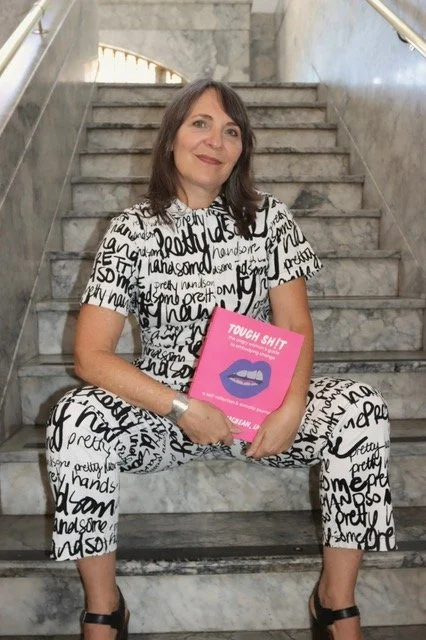
What if the answers you've been searching for aren't in your head, but in your body? Somatic psychotherapist, choreographer, and author Arianne MacBean joins Kara Duffy to explore the connection between our minds, bodies, and emotions, and why so many of us have learned to ignore the very signals that are trying to guide us.
Together, they dive into the power of somatic healing, how generations of cultural conditioning have taught women to suppress their feelings, and why reclaiming anger can be a powerful catalyst for change. Arianne shares how to recognize the body's signals, create environments where we feel safe, and stop accepting the things that leave us feeling disconnected from ourselves. They also explore birth trauma, intuition, the different parts of ourselves, and how we can transform difficult emotions into meaningful action.
“[About Somatic Healing]...I can’t promise you that you’re gonna feel better, but I can promise you that you’re gonna know yourself more deeply, and you’re gonna know yourself more wholly, and you’re gonna know yourself more intimately.”
-
-
388_Arianne MacBean
===
[00:00:00]
Speaker 2: Welcome to the Powerful Ladies podcast. I'm Kara Duffy, and today's guest is a somatic psychotherapist, writer, educator, and former professional dance and choreographer based in Los Angeles. She's a licensed marriage and family therapist and runs Synergy Somatic Psychotherapy in Pasadena. Her work combines traditional talk therapy with body-based approaches, deep psychology, and creative practices.
In this episode, we talk a lot about finding safety, why there are so many micro stressors in our lives, and what we can do to remove them, what somatic really means, how we can reconnect our mind, body, and soul, and the cultural expectations around anger, rage, and how we can channel that to do good work.
Kara Duffy: well, I'm excited to speak to you today because I'm a little bit obsessed with somatic healing [00:01:00] and women reconnecting their brains and their bodies. And I'm really interested in your journey because you've gone from the world of dance, which you've stayed in tandem with, into this therapy space, and you found a really unique connection between the two. Before we dive in and get into all the juicy bits what is your name, where are you in the world, and how would you describe what you're doing today?
Arianne MacBean: my name is Ariane MacBean. I am a somatic psychotherapist and choreographer, and what I do today is I work with individuals, couples, and families treating trauma and everything in between with, talk therapy that's rooted in the body. So it's a kind of return, always a cyclical return between feeling, thinking, and s- the sensorial information that we have [00:02:00] access to in our body
Kara Duffy: I really wanna start with just kinda setting the stage for how have we gotten to a place where these three fundamental things are not connected, listening to each other, maybe one or two are turned off? Like, how have we gotten to this point in our lives today?
Arianne MacBean: Well, it happened thousands and thousands of years ago when the early civilizations that revered the Great Mother as the Earth in tandem with the moon, the cycles of the moon, the seasons, the equinox, the cosmos. And we were sort of Conquered by the more warlike, civilizations that had access to metals and swords, and they revered the sun god, and that was the beginning of patriarchy, which we know of, which then became really about power. When the written word came into existence, it was the priests that [00:03:00] were, at that time, mostly men. And, the word was powerful, and priests became the intermediaries between the divine and the people. And, we moved from civilizations that were really in harmony with the cosmos and with the Earth, and that harmony actually meant respect within the body and without, outside of the body. And so when we moved toward a more monotheistic, warlike power, agricultural civilizations was eliminated, and women didn't have as much access to the divine. In fact, when civilizations were conquered, what happened is the men were killed and the women were incorporated into the oppressing winner.
And so what did women have to do? They had to survive. And of course, we now know, and I can say myself included, the patriarchy lives in me. And when I work [00:04:00] against that with my embodiment practice, I'm working against thousands and thousands of years of messaging that says, " Don't trust your body.
Kara Duffy: On a personal level, and I've talked about it before on this podcast, I know I'm aware of having to reconnect my mind and my body from the sense of having been a college athlete and been taught to ignore what your body's saying and use your mind to keep it going despite whatever you might be feeling, pain, stiffness, cold, like the elements.
It's like you can separate the two and make your body do things that it doesn't wanna do. And so I know even on that, in this lifetime experience for me personally, I'm just now starting to reconnect and listen to what my body's telling me. I'm the classic example of, it takes me getting like completely knocked out by an illness before I stop or listen, and we're trying to work on that so I don't have to keep getting sick as an example.
I hear this story from so many other women and some men too that like there's [00:05:00] just this disconnect in listening to ourselves for, from just a healthy perspective, but there's also this lack of trust. There are so many clients I have that will call me and say "Who do I need to discuss this project with?"
I'm like, " Have you talked to yourself about it?" And I'm like, "You already know the answers." I can validate them for you. I can reflect them back and say "Yes, that's a good business choice," but have you even checked in with yourself yet to see if you know? and I know for me personally, whenever I am in a practice of checking in with myself and listening the level of flow that shows up is shocking versus the days and/or weeks or months that I'm not doing that.
What are you seeing showing up when, on the people who are calling you and asking for help? Are you seeing the same patterns with everyone?
Arianne MacBean: It's so interesting that you talk about the messaging that we have in our own heads around pushing through.
I call it white-knuckling it, this mind over matter situation. Well, we could get through anything. That again is a message [00:06:00] that our country, the United States of America, was built upon. So, we're 200-year-old country. we... When we work toward embodiment, when we work toward flow, we are working against the messaging upon which, our society as we know it was built. The title of my book is called Tough Shit: The Angry Woman's Guide to Embodying Change. This, this phrase, tough shit, has a history of oppression and repression.
We all heard it. Who, who amongst us has not heard when you complain, "Oh my God, my back hurts," or, "Oh my God, I, I am so exhausted." "Tough shit. that's life. Don't scr- don't cry over spilled milk. That's the way the cookie crumbles. Pull yourself up by your bootstraps." There's over 20 idioms in the English language that mean repress your feelings
So yeah, of course.
Of course we have a hard time [00:07:00] listening and getting quiet And here's the second part to what you kind of talked about. When I'm with my clients and when I first started my practice, I was coming from having worked with somatics and memory and trauma from a creative slant. And when I started working therapeutically, there was this moment where I thought, "Well, is this gonna cross over?"
Will it work? And I ha- and still to this day, sometimes I'll go into a session going, " I wonder what will happen if we go to the body today. Maybe this will be the day where nothing happens and, we get stuck." And every single time, even if, quote-unquote, nothing happens so much is revealed when we go to the body, when we sit with whatever shows up or whatever does not show up. And, I was thinking this morning, I was taking a walk and I... It seems so obvious to me, like when I say it out loud, that it was like an aha moment. I was like, "Oh yeah, the mind is in your [00:08:00] body. The heart is in your body. The soul is in your body." Okay, so the body is the divine container. So why don't we go to the body to resource all of these aspects of self?
Kara Duffy: I mean, I think it is an aha for a lot of people listening as well because they've, and maybe this is also part of the, the cultural patriarchy that we've been talking about of everything is separate. So why would we think that they should be connected? I think a lot of people have heard the word somatic and think they understand it, but in reality if you're sitting down with yourself or another therapist to do a somatic exercise what does that look like? From the simplest to the maybe most extreme version of like what's in the range of a somatic approach or start?
Arianne MacBean: Yeah. It's a great question. I'm actually working on a, my-- I just completed my second book. I'm looking f- I'm looking for a agent and a publisher. It's called Back Pocket Somatic Psychotherapy, and in, in-- There's a section in it [00:09:00] where I really talk about the range of what somatic psychotherapy is for me.
And I get this question a lot "What does it look like? What is it?" Because it-- Som- soma means of the body. Somatic is an approach of the body. And psychotherapy, obviously, is the therapy of psyche. So somatic psychotherapy, again, is this kind of dance of psyche and soma, body and the unconscious and the conscious material that makes up our emotional world and our behavioral world. So in my work, Somatic is like an umbrella term, and within somatic psychotherapies, there are many modalities. I would say 12 that I can think of. There's Hakomi method, there's somatic experiencing, there's EMDR, there's brain spotting. of course, there's dance movement therapy.
[00:10:00] Even yoga is considered a somatic practice. So in my approach, coming from a dance background, and I have a certificate in somatic psychotherapies and practices. I don't have a certificate in one modality. I use all of the knowledge that I have as a dance educator, choreographer, and my certificates and my psychology and depth psychology master's degree to have a full range.
And from one side to the other, it-- The simplest would be we sit, we talk, and then I ask you, " How's your body feeling right now?" And what's coming up? And literally what do you feel? "Oh, well, I notice that my stomach is gurgling." " Ah, okay. Stomach is gurgling. What else?"
Oh, I just noticed that I relaxed my jaw."
" Huh, okay. You relaxed your jaw. And we were talking about this, and w- how do you relate those two, or do you not?" So it's really simple. The next step would be maybe we go into a little bit of a deeper relationship with those, those sensations. So "Let's stay a little [00:11:00] longer with the gurgling.
What's happening? What does it look like?" "Well, actually, it really feels like something's kind of moving around in there. Something's..." So we just sort of stay with it. We slow down as information, not as an answer,
Not as a interpretation, not as an equals sign.
But I think of it like a bridge, like a metaphorical bridge. So that's one simple end of the spectrum. And then the other end of the spectrum could be literally, inviting the body in certain moments during session to lead. So taking a pause away from a verbal expression, but actually moving from the couch into the space and letting the body...
waiting for the body to give us an impulse, whatever that is, as we hold this emotional space, this memory, this, this pause in the conversation, and we let the body lead through movement, through [00:12:00] shape, through maybe involuntary little quirks or pulses or, And just, and then maybe it becomes full-bodied movement.
Maybe it becomes different kinds of pedestrian movement, getting down on the floor, get it taking a shape, shaking, rocking, and just let incorporating that, incorporating the body's response into the therapeutic treatment.
Kara Duffy: I've done the brain spotting, which I think is so fascinating as a modality. I've done the listen to your body part, what is it saying? I've done even like tapping. I've done, just even simple like hands on your heart, Just are you even listening? Does your body exist in your consciousness right now?
Your awareness, I should say. And then I've had other friends who have done some m- somatic therapy where they're throwing a ball while answering questions, and they don't notice that how they're throwing the ball changes. Their therapist does. It's really interesting to me how there are things that we are conscious of and unconscious of as we go through [00:13:00] this process.
And, i've had yoga classes. I've been in like a HIIT workout class. I've had someone doing like psoas massage therapy, all of which have triggered me to cry, and I didn't know why. I knew I had to just not stop it, I don't know why. I was doing a bench press and suddenly it released something.
and so people who are listening who are like, "Okay, I'm sure I have something stored up in places," 'cause we all do as humans, and, " Oh, my back's now been hurting for a couple months. I d- haven't known why." How can we start bringing people in to be open to working with someone like you or even just thinking about their body in a different way right now?
now
Arianne MacBean: One of the things that I think is a bit of a turn-off for people with somatics is it's too woo-woo, because quite frankly, somatic healing works differently than some of kinds of other therapies, certainly cognitive behavioral, most talk therapies, "oh, let's-- we're gonna talk about this thing, we're gonna process it, and then we're gonna get over it." [00:14:00] Somatic psychotherapy, like you said, I'm doing something and I don't realize it, but then this emotion comes up, and I don't know why, but I know that I need to keep it there. Somatic psychotherapy is very close to a kind of more analytical or depth orientation, which is that the healing process is not necessarily in a language-oriented, linear cause and reaction paradigm. It is a feeling sense. It is backwards and forwards, it is cyclical, it is metaphorical. It doesn't necessarily have language, although we can bring language to it. Sometimes it's really hard to describe what we feel in our body. We actually have to describe it with movement, or we have to describe it with a facial expression, or we have to describe it with a sound.
It's like, " Ugh," so yeah. I think it's a tough sell sometimes because [00:15:00] people want to feel better, and they want to be told, "If you do this, you will feel better." I'm always saying, " I can't promise you that you're gonna feel better, but I can promise you that you're gonna know yourself more deeply, and you're gonna know yourself more, more wholly, and you're gonna know yourself more intimately." And as you do that, you get closer to some of the harder parts of yourself that are harder to face, and then you get closer to the parts that you can love and that are as close to the divine or the infinite Or soulful.
Kara Duffy: Mm-hmm. Well, and I think that so often we are looking for something that makes sense to us. Like our, we can't turn our logical brains off enough to just accept it doesn't make sense, but we feel better, so it's okay.
Arianne MacBean: Well, yeah, and here's the other thing though, and maybe you've had this experience. When you know something in an embodied manner, it is undeniable in a way that no word or [00:16:00] phrase or sentence or line in a book could ever be known. An embodied way of knowing Is undeniable. Can you agree?
Kara Duffy: Yeah, and I'm thinking about like practices I will do often of just allowing my intuition to lead more. I think maybe this is the language that some of the li- the listeners anyway, like talk about more often. If we're gonna go down the street and like just doing a, an intuitively guided walk, which sounds so woo-woo, but all you're doing is walking and you ask yourself, "Okay, left or right?"
And you just kinda keep choosing based on hopefully what you feel and not just making a choice in your head. But just trying to bring that connection back where we don't need the linear, logical side to be in charge. How can that feeling based part be in charge and to trust that it's not gonna take us, you know, literally down the wrong path in that moment.
I think it's a big deal because we're again, culturally told that, yeah, we talk about having a gut intuition, [00:17:00] but then we're told, " I don't know, can it be trusted?" Like it doesn't make sense.
Arianne MacBean: I'm looking this up right now. There's an amazing book that I love called The Women's Intuition. I love the book. And I base a lot of my work and practice off of it, A Woman's Intuition. she was a Jungian analyst who worked with somatic healing and one of the stories that I will remember from it is that she talks about feeling some kind of presence in her body around her belly. And she didn't really know what it was, but she would sort of notice that she would just rest her hand on one side of her belly. And it turns out she did end up, going in for a checkup and she had a cyst on some part of her body, that needed to be removed.
She noticed as the time was going towards the surgery, she just naturally would rest her hand there. And then she started to really attune to that, just sit with her hand there and sit and just focus [00:18:00] there and just feel the heat and feel the pressure and just really be with the somatic sensory feeling.
And when they went to remove the cyst, the doctor said he had never seen anything like it, but there was a film, a protective film of some kind of tissue around the entire cyst. He said he'd done hundreds of these and had never seen anything like it. And she connected it with just her intuition that this part of her body needed care and attention. And it's so funny that you talk about the intuitive walk. I have a group of girlfriends, we've known each other since we were in fourth grade, and we live all over the country now, but we get together once a year and we, when we were in fourth grade, we called ourselves the Adventurous Adventurers.
We were really nerdy. But you know what our thing was that we used to do? We would get together on the weekend and we would walk the neighborhood and make up these adventures. And when we got to [00:19:00] a place where we had to make a choice of which road we would go on, we would do rochambeau to choose which road we were gonna take. And we would make up these crazy capers and kidnappings and adventures, and were just doing intuitive walks.
Kara Duffy: I think it's fascinating. And, having your background in dance, ' cause dance can be another example of actually separating brain and body to go through some of the pain and everything else that can come with professional dance spaces. How does having that connection with your body in dance form help, and what have you personally had to kinda overcome to reconnect your parts?
Arianne MacBean: That's a really good question, and I don't think I realized until I went back to grad school at age 47, after a full adult professional life in dance, that I had been pretty disembodied. As much as I thought that I was a smart dancer. [00:20:00] So that realization came at a really interesting, unexpected...
you can't force this shit. You just can't. It's you're not ready until you're ready. And I was working with my dance theater company, the Big Show Company. We had been working with veterans in a memory project for about five years. We had completed this beautiful process with a performance at the Ford Theatre in LA, where the veterans performed alongside the dance theater company. It was called The Collective Memory Project. We were starting our second project, and I asked everyone at the table, as we usually worked, we would write, and then we would move, and then we would write, and then we would talk, and then we would move, write, and then we would move and talk. And I asked everyone, "What do you need for the next part of this project?"
And I wrote, " I need to understand the language and have the skills to manage the healing that's going on here." I knew through doing [00:21:00] the Collective Memory Project that there was-- this was therapeutic work, moving and speaking together and turning our memories into script and text, expressing it through our bodies.
But I didn't really understand why. So that was when I returned to grad school. So my intention really was to do this work so that I could go back and do the choreography in a different way, understand the choreographic process. I'm just now, six years later, making that full circle and starting a, a project with two other dance members of the dance company to see if we can apply some of these more embodied paradigms to the choreographic process.
And I'm not sure we can. I was fine and okay with never making a dance again because I really did actually have a kind of somatic refusal as I started to Understand what embodiment was. My body [00:22:00] literally, when I would see dance, I would have to avert my eyes. Again, around the patriarchy, sorry. I mean, I hate to sound like a cliche, but you know, the separation of the audience, the paying audience in the dark, the performing body, the male gaze, the authority figure of the one, the choreographer as the authority the confines of the stage. Everything that we know about somatic embodiment is based in real felt connection And that feels like the antithesis of watching someone do a leg extension up to their ear, so you see their crotch shot and going, " Ooh, wow. Cool." That's not being kind of embodied somatic creative force that feeds the soul for me
Kara Duffy: Well, the conversation that I've been having with friends I had one yesterday about this. There's such a [00:23:00] return to Maslow's hierarchy of needs, and I use it often in business coaching with clients. I just saw a YouTube where someone was talking about does your home make you feel safe?
Where are we allowing low or high levels of interference to be a part of taking up our space for our brain, body, spirit? And we don't have a lot of conversations about do we feel grounded and safe and secure? Even simple things like, are you having to work all day with your back exposed?
Human nature is that's not gonna calm you down. And so I'm curious for you, like how does the safety element come in? 'Cause even talking about the girl who can kick her leg up, she's making herself physically very vulnerable in that process. So where are the layers of safety and feeling calm, and how much should we be prioritizing that in our lives in general?
Arianne MacBean: this is everything. So my next book is a therapeutic concept paired with a somatic experience, and they're real therapeutic concepts that come from session, from real sessions. And one of them [00:24:00] is safety is everything. And it's one of the first in the book. Safety is everything.
There's a meme going around. Have you seen it? It's a whole bunch of kids, and they go, It's one of those things where you ask a kid to fill in the sentence "You live in this house, so..." And it's like, "You live in this house, so..."
And then you get like, "So I have to follow your rules." " I have to do what you say." "I have to do my chores." " You're the boss." And at the very end, this little girl goes, " To be safe." And my whole body just like, oh, you know? I like to be safe. How many of us grew up thinking we live in our house so we can feel safe not very many of us
Kara Duffy: There was an, a whole era in the what, 2010s, early aughts maybe, where everyone was talking about minimalism and KonMari-ing, and this like kind of reclaiming our spaces to only have what we love and like essentially.
And it was a radical concept that the space that we're in [00:25:00] charge of, we don't have to tolerate things. And I feel so often in, in the alignment-based business coaching I'm doing I'm asking people like, "What are you tolerating?" If you're tolerating stuff in your business, you shouldn't be.
So let's fix that. Let's fix the stuff we're tolerating. And I feel like that's happening in a, at a physical space level with the minimalism, the KonMari, the we can powerfully choose. And then I'm starting to see it creeping into communication styles at a bigger conversation level. Does this friend make you feel safe?
Does this person? ' Cause I'm just flabbergasted at if we separate parts of our life and really look at, do we feel safe in them or what are we tolerating in them? 'Cause sometimes we can't even get to the safety level yet, like it's too big I think for us to think about. There's so much nonsense that we're tolerating all along the way. Either things being out of integrity or we just don't like them, or even more extreme, getting from like little T to big T trauma stuff.
Arianne MacBean: Yeah, I think it's really confusing. Again, going back to [00:26:00] messaging, we were told-- I grew up in the ' 70s, at that point, you can be whatever you wanna be, but then I also had the message, My parents divorced when I was a baby. My parents had equal joint custody.
That was supposed to be very, egalitarian in the '70s. So I was really half and half, and I remember complaining to my mom about my dad, and she would say, " Just, your dad loves you, and be happy that he's in your life because a lot of divorced fathers don't have anything to do with their kids." This was a message that I got over and over again around be happy that you have what you have, even if what you have isn't hitting, isn't making you feel safe, isn't making you feel happy, isn't making you feel good about yourself. And I think my mom probably was telling herself that, " Yeah he's hard to deal with, but, at least I have someone to help me." But as women, we're so used to this idea [00:27:00] of be happy with what you get, that the idea of actually being like, "Do I need to tolerate this?" Isn't even a concept that comes into our minds. I was an avant-garde dance theater choreographer in LA, so what did I tell myself all the time? "Be happy with the scraps that you get. Be happy that you have a job that you kind of hate because most dancers don't have any jobs. Be happy that your piece got seen by the festival adjudicating group but didn't get picked."
I had to be happy with not being happy, and I think that is done. I have moved, thankfully, through to the other side of no, I'm redefining what happiness is, A. And I'm gonna cultivate this geography and this environment to have its own ecosystem of replenishing and validation and stability.
Kara Duffy: And I'm someone who loves reading about the human design idea [00:28:00] as well, and I'm a generator. And they always say with generators, if it's not a full body yes, it's a no. It is really hard to first hear a body yes of any size, let alone a full body yes. And it's a really interesting thing. I have to keep checking in with myself of, am I a full body yes?
And there are things, I think, as you go throughout the day where it's like, am I a full body yes to this yellow cup? I don't know, but it's here and I gotta keep going, right? and There's moments I have to throw it away to keep things moving, right. And then other moments you're like, "No, we have to stop and really check in.
Is this a full body yes?"
Arianne MacBean: Well, I wanna also invite you to the, the cellular yes. So on the opposite of the full body yes would be the cellular yes, our self is made up of cells, and if you take one cell and out of us and you put it in the palm of your hand, that is the essence of you. And I think sometimes we only have three [00:29:00] seconds, five seconds to check in, and we can check in with that cell. And instead of like, "Oh my God the whole body's gotta..." Because we've got so many parts. We've got so many conflicting parts, but if we go to the one cell, sometimes that's another, a reframe where we can just be like, "You know what? The one cell says good enough. Good enough. Yes. Yes with a lowercase Y, and I'll take it."
Kara Duffy: one of the things that you list on your website of, like, all the ways that you can help people, and there's a lot is birth trauma. And this is something that is in the world of things that I have a hard time wrapping my head around in its entirety. So I understand the concept of birth trauma for the person being born, and it's very shocking and not where they were, like, three seconds ago.
And there can also be, what we would culturally call trauma moments where there was an issue, there was something went wrong. There's things that you would be like, "Oh yeah, like I understand that being traumatic." what I don't understand is the [00:30:00] full breadth of maybe the little T end of what can be in the scope of birth trauma. So I figured I'd ask you if you could help myself and everyone else kinda understand it in its fullness.
Arianne MacBean: Well, I love that you articulate the two because sometimes people hear birth trauma and they only part that they think of is the mother giving birth and that there's some trauma with her with that transition. but there's also the trauma of the infant being born. We've got two things that are one for a while and then they s- become their own.
With it, for the mother, birth trauma isn't just about giving birth. It's also about pregnancy loss, deciding to terminate pregnancy, not infertility, Or trying to become pregnant and all of the different experiences that come with that. So for the mother alone, there are a lot of roads. I would say in general, archetypally, we're [00:31:00] moving from maiden to mother.
whether that pregnancy goes to fruition or not, whether we decide to terminate, whether we adopt out, whatever is that is decided, whatever happens there, there is an identity shift for the woman. And that actually also includes choosing not to have children.
There's so much around trauma work or just identity work. For the child, so much more research is going on now that we understand that what's happening in the mother's body when the infant is growing into an actual hu- when the embryo is being born, developed into something that's viable to live outside of the body, there's a symbiotic relationship there.
I've heard a story many years ago about a teenager who was coming into puberty. So her hormones were changing and right when the, her hormones were changing, she developed [00:32:00] incredible anxiety and was in therapy for quite a while, and they mapped that actually at a certain point in the pregnancy between, I believe, the first and second trimester, the mom was studying to finish her dissertation. And as she got closer to the deadline, her anxiety skyrocketed as she was trying to finish this. And we were able to map over, oh, well, when her daughter's hormones were shifting, she went through a kind of mimicry rite of passage that her mother was going through when the daughter was in utero. So there's stuff that's happening during the pregnancy, and then there's the birth itself.
It ain't nothing, talk about safety of the womb into the world. And, one of the things that internal family systems as a theory that a lot of somatic practitioners use because it, it works really well. They have this idea, this theoretical approach that we [00:33:00] have a self that is untouched and, always okay, and that we have it from the minute that we are born, and that the self develops parts to keep it safe. And those parts might be, they call them the protectors or the managers. And a protector might be, like, a defense or a manager might be an anxiety.
And there is this notion, I'm not sure if I believe in a self that is solid from the moment we come out of the womb. I think that self is continually developing. But I do love this idea that, again, like the cell, that there is a kind of pilot light is always burning in this container. And the more work I do, the more I sort of relate it to a soul, to the s- to the soul
Kara Duffy: For people who haven't experienced the family systems, I always correlate it to the movie "Inside Out," where maybe it's not [00:34:00] happiness or joy, but it's here's your protector, here's the perfectionist, here's the scaredy cat. Like, which one's showing up and which one needs to be calmed down and remember that you're in charge, because they take over if they're allowed to.
Where but I always know that I can check in with myself and be like, "Okay, what part is trying, is thinks they're in charge right now?" And then if I come back to that pure light, like the balanced version of me, I'm like, "Okay, we're back to whatever that center core might be," as you were talking about.
But it's so valuable, and we intuitively know these things. Oh, my perfectionist side is showing up," and we just let it keep being in charge, and you're like, "Do you want that one in charge?"
Arianne MacBean: It's a really valuable theory. I think separating our parts from ourself really makes them feel like we can be in collaboration with them rather than them driving the bus. I do the same work with anyone with depression or anxiety or OCD. It's a part of you. It is not all of you. It can [00:35:00] feel sometimes that our depression defines us but it's a thread, and there are other parts that we can build.
And by the way, that's something that we do a lot in somatic psychotherapy is we build structures in our bodies that we feel that we need. We can build, a counterpoint to depression. We can build it if in our chest and our shoulders. We can build it in the top of our head.
We can build it with moving energy and m- or visualizing certain kinds of lightness or action. We can build it in our feet. Yeah it's an imaginal process and I think it dips... It points us back into play. It points us back toward our creativity, which is why I think coming from my dance theater background, it just feels like such a wealth of interventions for a therapeutic experience
Kara Duffy: Well, and it takes us away from limited thinking. And I think this is where we tend to [00:36:00] butt up into language sometimes because there was Brene Brown's book, "Atlas of the Heart." I liked it simply for the fact that it gave so many different definitions or clarity on what different feelings were.
Even the... I always go back to her separating envy and jealousy, because when we don't have the vocabulary to explain how we're feeling or even the permanence versus impermanence of feelings, like I-- The English language can be really frustrating because in others, like Spanish, we have a, " I am feeling temporarily this," versus, "I am fee- I am this permanently."
And I think that also just layers into it. The ability to say I am currently feeling depressed," versus, "I am a depressed person." It's th- one is, to me, is so much more empowering than the other because it gives us choice and options.
Arianne MacBean: I mean, you are hitting on something that, really was at the crux of me becoming a dance theater choreographer because, yeah, I believe that movement is an expression that is universal, but also not. [00:37:00] And I am constantly floored by the way language fails us. one of the things that I always did in my work, and still do, is try to expose the ways that words and movements Support each other, conflict each other, contrast each other.
There's this line in one of my dances, "Hold me while I try to get away." And the woman is taking the man's arms and wrapping them around her, and then she's running in his arms. And then she kind of breaks free, and then she comes right back and says, "Hold me while I try to get..." And does it again. And, that play of words and movement. There's another line in another dance where a, a dancer is... she's, running as fast as she can into a group of dancers, and she's saying, throw me away." And then she crashes into them, and then they throw her, and then she says, "Again."
And they throw her. It's wanting... Catch me and throw me away. It's r- it's ha- You see? It's [00:38:00] hard. It's hard. There's no words. That's why the guttural, the utterances, the, the spaces between words that's where we do the healing in somatic psychotherapy
Kara Duffy: I wanna come back to your book and the journal and how people can use it because, when you... Both of those stories you described and the choreography, I correlated to relationships. And when you see someone saying they wanna leave and not being able to leave, it registers differently than them just talking about it.
The language part is one level, but when you see it in that exaggerated context of what is actually happening, it's like, "Oh, yeah. Okay, hold on, and let's go further." And so when we look at your book and journal the tough shit that you were showing us before,
Arianne MacBean: Yeah
Kara Duffy: many people are using it for reclaiming their anger and rage they're feeling, whether you know why you're feeling it or not.
I am someone who actually got challenged once to be [00:39:00] like, "Do you even know what rage is?" I'm like, "I don't know." For me to get angry takes a lot, and even when I'm angry, I'm probably at someone else's calm still. And I don't know if that's healthy or not. Doesn't occur to me as on my top list of priorities to worry about. But the having a place to be a woman and be mad and have just feelings in general
Arianne MacBean: Yeah
Kara Duffy: feels so limited sometimes.
Arianne MacBean: Exactly. I wrote this journal because of exactly what you just said. Women were coming to me for one 50 minute session a week
to talk about why they had so much anger and what to do with it, and they had no other place to do it except this therapy room. And I'm like, " There is not enough time in this 50 minute session for us to be able to do what, what really needs to be done."
And the first thing, as you said, is that when you feel anger, you have to feel it. And I would say for you, as someone who doesn't necessarily feel, anger, using the body and really [00:40:00] slowing down, even if you have a hint of anger, to notice what sensations, how it shows up in your body.
And it's different for everyone. Not everyone feels somatically anger as loud or, forward leaning or clenching or heat. Some people feel anger as cold or locking or icy or locked, some people feel anger as totally messy. And so if it's it's just, it's like oozy, and it just drips, and it's almost disgusting to them, and they have to kind of...
So as a way of dealing with that disgust, what do they do? Right? They gather it in. They go way... They disassociate, right? So anger shows up differently for everyone, but it is the most somatically felt of the emotions
Kara Duffy: Fascinating
Arianne MacBean: It's also a secondary emotion. Carl Jung said that there was a reason why we [00:41:00] say he's gotten away from himself when he's angry. He's gotten away from himself. Anger takes us-- is the outward explosion, expression of some primary emotions that are going on inside. And this book helps you map that. So it starts with anger as with writing prompts and somatic pop-up experiences. And notice I call them experiences, not exercises, because they're not put your arm here and twist and look, these are actually somatic experiences are ways to just fucking connect with your body. It's really that simple. You don't have to do much. I think that's the other thing is that people think somatic is gotta be like, " I gotta follow this thing with my eyes, and I've gotta tap, and I've gotta," it's no.
So although those are great for, they do work. So it starts with anger, and then it you move through backward through fear, [00:42:00] sadness, hurt, and then the final section is true self. And that's where you do the work of trying to understand your road of reactivity and use it to understand who you are in that moment and how you might wanna move forward to actionable change, knowing this about yourself, knowing this road of reactivity
Kara Duffy: I mean, I think it's fascinating, and we're certainly in an era where women have more things to be frustrated and mad and disappointed about. And it doesn't, it for the list isn't getting shorter right
Arianne MacBean: No, no
Kara Duffy: but we're also in a time when women need to be able to process it so we can be the change that has to happen right now.
I love that this tool exists for us to get things down and out of our bodies and then decide how we wanna proceed.
Arianne MacBean: Yeah. I mean, this is the key. So the way that you have been seeing anger used since, for 4,000 years, okay? We're [00:43:00] talking 4,000 years of patriarchy Is that anger is used to dominate and to blame and to other, and you see it happening now. What anger is actually supposed to do is to be information about ourselves
Kara Duffy: Mm-hmm.
Arianne MacBean: We've lost that. It's supposed to be information about what we value and how we want to lead our lives, not about defining other people
Kara Duffy: Well, I am very glad that you are doing the work you're doing. I'm very thankful that you've written this, and I'm excited about your upcoming books as well. This has just been such a juicy conversation, and we could probably keep talking the rest of the day. But really thank you for the work you're doing. It's so needed. I'm glad that you're out there in the world kinda holding up your part to make things better.
Arianne MacBean: Right back at ya.
Kara Duffy: For e- for everybody who would love to work with you, get the book, get the journal all the things, how can they support, connect, and follow you?
Arianne MacBean: My book is available everywhere books are sold, Amazon, Barnes & Noble. My [00:44:00] website, Synergy Somatic Psychotherapy, has all sorts of information, some freebies. I developed a tough shit cocktail, that you can get the recipe for that turns some of the old patriarchal use of gin to suppress women into a empowered, delicious cocktail.
there's also some a beautiful, amazing Spotify and Apple Music playlist, tough shit playlist put together by a DJ of raging feminist music to just throw on any time you need to let that rage out. And I'm often in LA doing somatic circles, and all of that information is on my website as well.
Kara Duffy: thank you so much for your time today. I cannot wait to hear everyone's comments and follow-up questions from this episode
Arianne MacBean: Me too. Thank you so much. It's been so much fun chatting
Kara Duffy: [00:45:00] Thanks for listening to the Powerful Ladies podcast. If you enjoyed this conversation, please subscribe, leave us a review, or share it with a friend. Head to thepowerfulladies.com where you can find all the links to connect with today's guest, show notes, discover like episodes, enjoy bonus content, and more.
We'll be back next week with a brand-new episode and new amazing guest. Make sure you're following us on Instagram or Substack, @powerfulladies, to get the first preview of next week's episode. You can find me on all my socials at karaduffy.com. Until then, I hope you're taking on being powerful in your life.
Go be awesome and up to something you love.
Related Episodes
Episode 357: Near-Death Awakening, Somatic Healing & the Power of Pleasure | Jill Jordan | Somatic Guide & Founder of Spiritist

Episode 231: What Happens When You Say Yes Before You're Ready | Ginger Fatale | Therapist & Dance Artist

Episode 203: Letting Go Of Who You Were Taught to Be | Parisa Frost | Therapist & Creator of Hiking Healers
SUPPORT OUR GUEST:
Substack: @writebig
Website: www.synergysomaticpsychotherapy.com
Instagram: @synergysomatics
Created and hosted by Kara Duffy
Senior Producer: Jordan Duffy
Music by Joakim Karud